

Grade 2 Ankle Sprain: Recovery Time, Treatment & Exercises
You come down the last two steps at Tanjong Pagar MRT, your foot catches the edge, and your ankle rolls. For a second, it’s just a jolt. Then the swelling starts, and by evening you can’t put weight on it without wincing.
That’s usually the moment people start searching for answers online. Fair enough; not every rolled ankle needs a clinic visit. But a grade 2 ankle sprain does, and knowing the difference matters more than most people realise.
This guide breaks down what a grade 2 sprain is, how long it genuinely takes to heal, and the exercises that separate a full recovery from an ankle that easily gives way.
What Is Grade 2 Ankle Sprain?
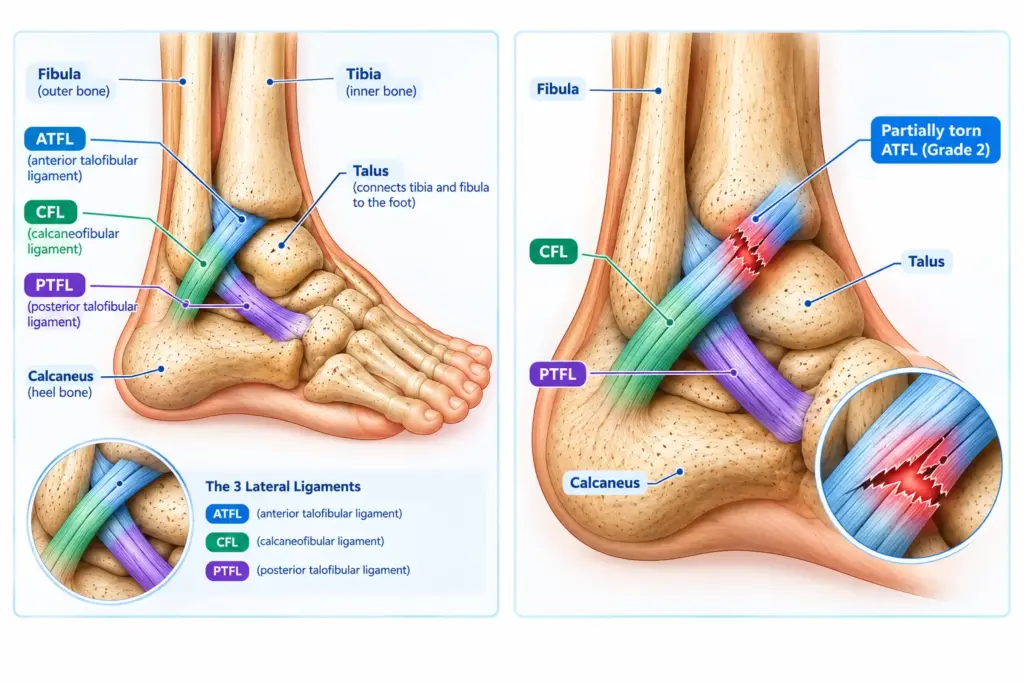 Your ankle is held together by three lateral ligaments: the anterior talofibular ligament (ATFL), the calcaneofibular ligament (CFL), and the posterior talofibular ligament (PTFL). In grade 2 sprain, one or more of these, usually the ATFL, has partially torn rather than simply overstretched.Ankle injuries can vary considerably in severity and ligament involvement, so understanding the different types of ankle sprains can help put a grade 2 injury into context.
That distinction is why grade 2 sits in an awkward middle zone. It’s not as mild as being able to walk if off like a grade 1 sprain. And it’s not as serious as needing imaging and a boot like grade 3 complete tear either. It’s a partial tear: enough damage to destabilise the joint but not enough to make weight-bearing impossible.
Clinically, we distinguish grade 2 from the others through a combination of the mechanism of injury, the amount of swelling and bruising within the first 48 hours, and specific stability tests (the anterior drawer test, for one, checks how far the talus bone shifts forward when the ATFL can no longer restrain it). Imaging isn’t always necessary for a straightforward grade 2 sprain; a physiotherapist’s hands-on assessment often tells us more about functional stability than a scan does.
Why Grade 2 Sprains Happen More Often Than You’d Think
Most grade 2 sprains here don’t happen drastically. They happen on escalators at Suntec, on wet tiles, or when someone misjudges a kerb. Add years of desk-bound work, minimal calf and peroneal muscle conditioning, and wrongly chosen shoes and the ankle simply isn’t prepared to correct itself when the foot rolls.
The sprain isn’t really about the twist. It’s the ankle’s stabilising muscles being too weak or too slow to catch the movement before ligament damage happens.
Grade 2 Ankle Sprain Recovery Time
Grade 2 ankle sprain recovery time typically runs 4 to 8 weeks, sometimes longer depending on your baseline fitness, age, and how quickly you start physiotherapy. Rest alone does not resolve the underlying cause. Rest reduces pain; it doesn’t rebuild the torn ligament fibres’ strength or retrain the proprioceptive signals your ankle lost the moment it rolled.
We map recovery against our 3-Phase Recovery Framework, adjusted for grade 2 severity:
| Phase | Typical Duration | Focus | What You’ll Notice |
| Acute Phase | Days 1 to 7 | Pain and swelling control, protecting the healing ligament | Swelling reduces, weight-bearing becomes more tolerable |
| Subacute Phase | Weeks 2 to 4 | Restoring ankle range of motion, gentle loading | Stiffness eases, walking gait normalises |
| Recovery Phase | Weeks 4 to 8+ | Strength, balance, and return-to-activity training | Confidence returns |
If your ankle is still swollen past day 7, or you’re not sure which phase you’re in, book an assessment and get a plan built around your timeline, not a guess.
No two presentations are identical, and treatment follows no generic protocols. A 28-year-old runner and a 55-year-old office worker with the same grade 2 diagnosis will progress through these phases at different speeds, and pushing either one faster than their tissue heals is exactly how a grade 2 sprain becomes a chronic one.
Grade 2 Ankle Sprain Treatment: Beyond RICE
RICE (rest, ice, compression, elevation) has its place in the first 48 to 72 hours. It manages swelling. It does not, on its own, constitute complete grade 2 ankle sprain treatment, and this is where a lot of self-managed recovery quietly goes wrong.
Effective treatment for a grade 2 sprain typically includes:
- Manual therapy to restore joint alignment and reduce compensatory stiffness in the surrounding foot and calf
- Graded mobility work, moving the ankle through controlled ranges before it’s fully pain-free, because prolonged immobilisation stiffens the joint capsule
- Bracing or taping during the subacute phase, not indefinitely, to support the healing ligament without letting the stabilising muscles switch off
- Manual lymphatic drainage techniques in more swollen presentations, where fluid buildup is slowing the healing timeline
- Load management guidance, specifically how much walking, standing, or stair use is appropriate week to week; this is the piece most patients guess at, and guess wrong. How much you walk during recovery can also affect symptoms, which is why it’s useful to understand walking on a sprained ankle and when activity should be reduced.
An orthopaedic review is warranted if there’s suspected fracture, if you genuinely cannot bear any weight after 48 hours, or if instability persists past the expected window. Otherwise, physiotherapy is the primary and appropriate pathway for a grade 2 tear.
Ankle Sprain Exercises: What Rebuilds the Joint
Ankle sprain exercises need to progress in a specific order. Jumping straight to balance drills before swelling has settled, or straight to strength work before range of motion has returned, is the single most common reason recovery stalls.
Phase 1: Acute (Pain Allows)
- Ankle pumps and circles, seated, well within pain-free range
- Gentle towel stretches for the calf
- Isometric holds (pressing the foot against light resistance without moving the joint)
Phase 2: Subacute (Range Returning)
- Alphabet tracing with the toes to restore full range of motion
- Resistance band work in all four directions: dorsiflexion, plantarflexion, inversion, and eversion
- Double-leg balance progressing to single-leg balance on a stable surface
Phase 3: Recovery (Strength and Stability)
- Ankle strengthening through calf raises, single-leg squats, and resistance band lateral walks
- Single-leg balance with eyes closed, then on an unstable surface (a folded towel works before you invest in a wobble board)
- Sport- or activity-specific drills: lateral hops, controlled pivoting, stair descent under load
That last progression, from a folded towel to an unstable surface, matters more than most home exercise sheets let on. Proprioception (your ankle’s sense of where it is in space) is usually the last thing to recover, well after pain and swelling are gone, and it’s the piece most people skip entirely once the ankle “feels fine.”
The Real Cost of Skipping This Step
Sports medicine literature puts the recurrence risk at 40 to 70% for people who sprain an ankle without proper rehabilitation. Not because the ligament fails twice by bad luck, but because the muscles and nerves around it never relearned how to react fast enough. Every subsequent sprain tends to be a little less predictable and a little more prone to lingering instability.
This is the pattern our physiotherapists across all 6 clinic locations see constantly: someone treats the swelling, feels functional by week three, stops the exercises, and rolls the same ankle again within the year. Ankle sprain recovery that stops at “pain-free” instead of “fully stabilised” is incomplete recovery. Once the ankle has recovered, targeted rehabilitation and prevention strategies can help prevent recurrent ankle sprains and reduce the likelihood of another instability episode.
When to See a Physiotherapist
Book an assessment if:
- Swelling or bruising hasn’t noticeably improved after a week
- The ankle still feels like it might “give way” during normal walking
- You’re returning to sport or an active job and want a clear, graded plan rather than guesswork
With 45 years of combined clinical experience across our physiotherapists, we build the assessment and exercise progression around your actual presentation, not a generic printed sheet.
A twisted ankle rarely feels urgent once the initial pain fades. That’s usually the exact point where untreated grade 2 sprains quietly turn into years of an ankle that never quite trusts itself again.
Book an assessment and get a recovery plan built around your ankle, not a generic timeline.
Frequently Asked Questions
What is a grade 2 ankle sprain?
A grade 2 ankle sprain is a partial tear of one or more ankle ligaments, most often the anterior talofibular ligament (ATFL). It causes noticeable swelling, bruising, and joint instability, sitting between a mild grade 1 overstretch and a complete grade 3 tear.
How long does a grade 2 ankle sprain take to heal?
A grade 2 ankle sprain typically takes 4 to 8 weeks to heal with proper physiotherapy, though timelines vary based on age, fitness level, and how early treatment starts. Recovery moves through three stages: acute (days 1 to 7), subacute (weeks 2 to 4), and full recovery (weeks 4 to 8 or beyond).
Can you walk on a grade 2 ankle sprain?
Limited, cautious walking is usually possible with a grade 2 ankle sprain, though it’s often uncomfortable and unsteady in the first week. Weight-bearing should be guided by pain levels and, ideally, a physiotherapist’s assessment rather than pushed through independently.
Is a grade 2 ankle sprain serious?
A grade 2 ankle sprain is a moderate injury that requires proper rehabilitation, not just rest, to avoid long-term instability. Left untreated, it carries a meaningfully higher risk of repeat sprains and chronic ankle weakness compared to a fully rehabilitated one.
What is the best treatment for a grade 2 ankle sprain?
The most effective grade 2 ankle sprain treatment combines early swelling control (RICE) with physiotherapist-guided manual therapy, graded mobility work, and progressive strengthening. RICE alone manages symptoms in the first 48 to 72 hours but does not restore the ligament’s strength or the ankle’s stability on its own.
Do you need a boot or brace for a grade 2 ankle sprain?
A brace or ankle support is commonly used during the subacute phase of a grade 2 ankle sprain to protect the healing ligament while allowing controlled movement. It’s typically not needed indefinitely, as prolonged bracing can weaken the stabilising muscles it’s meant to support.
What exercises help a grade 2 ankle sprain recover?
Ankle sprain exercises should progress in three stages: gentle range-of-motion work (ankle circles, towel stretches) in the acute phase, resistance band and balance work in the subacute phase, and calf raises, single-leg balance, and sport-specific drills in the recovery phase. Skipping ahead to strength or balance work before range of motion has returned is a common cause of setbacks.
How likely is it to re-sprain the same ankle after a grade 2 sprain?
Sports medicine research consistently reports the recurrence risk at 40 to 70% without proper rehabilitation. Completing the full strength and balance phase of recovery, not just resting until pain subsides, is what meaningfully lowers that risk.
Tags : Ankle Injury, Ankle Rehabilitation, Ankle sprain, Ankle Sprain Exercises, Ankle Sprain Recovery, Ankle sprain treatment, Ankle Stability, Grade 2 Ankle Sprain, Ligament Injury