
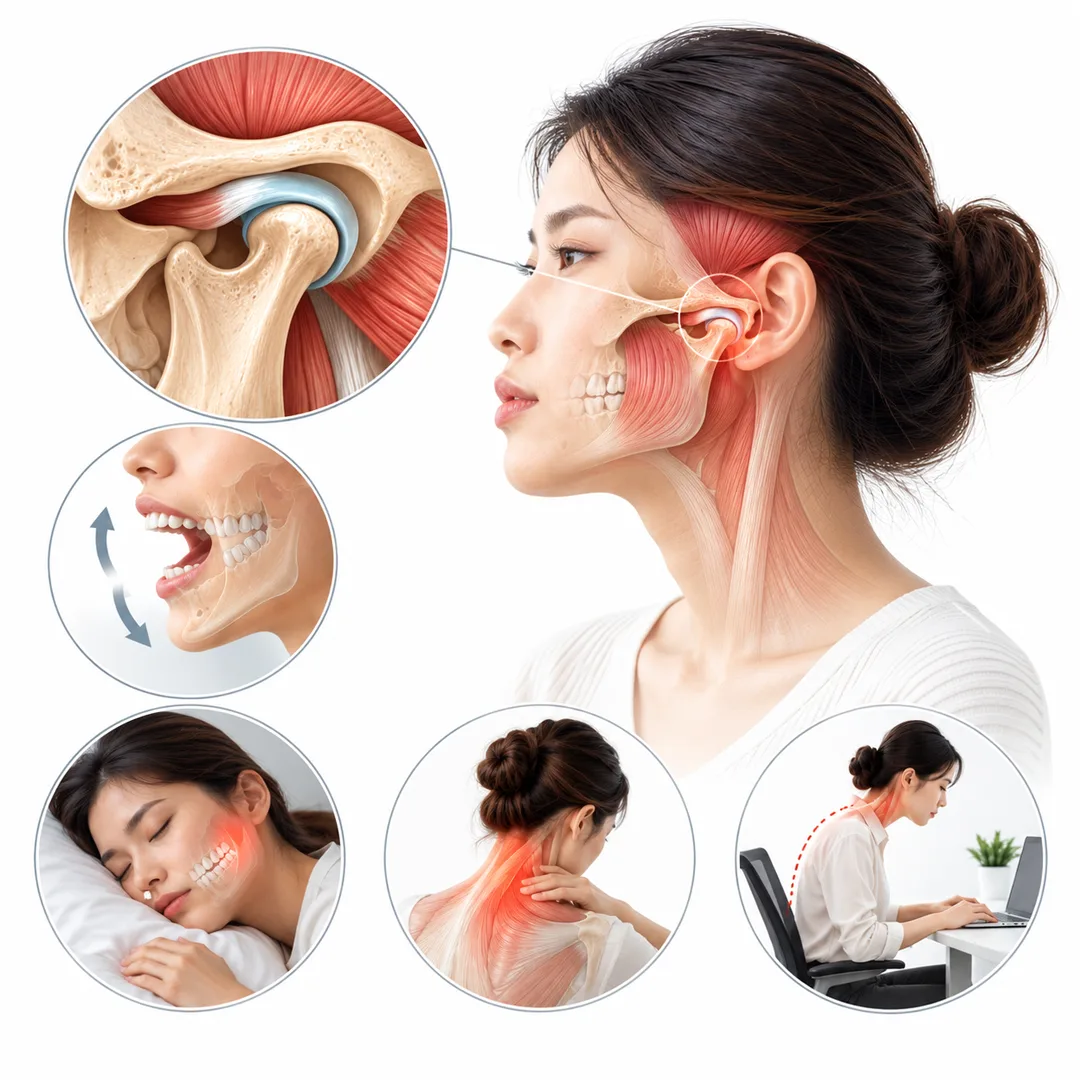
What Is TMJ Physiotherapy?
TMJ physiotherapy treats dysfunction of the temporomandibular joint, the joint connecting your lower jaw to your skull. Unlike most joints, it works as a matched pair: both sides move together every time you talk, chew, or yawn.
A small cartilage disc sits between the jawbone and skull, letting the joint glide smoothly. When that disc shifts, or when the surrounding muscles (the masseter and temporalis) stay in constant low-grade contraction, you get the clicking, popping, or grinding that brings most patients into our clinics.
TMJ disorder rarely comes from one event. It builds from repeated mechanical stress: bruxism (grinding or clenching, often overnight), postural strain from hours at a laptop, asymmetrical chewing favouring one side after an old dental issue, or muscle guarding following whiplash or dental work.
In Singapore’s desk-bound work culture, we see a consistent pattern: forward head posture from long screen hours feeds directly into jaw tension, because the muscles stabilising your neck also anchor your jaw. Treating one without the other is often why a mouth guard alone doesn’t fully resolve the pain.
At Rapid Physiocare, assessment findings shape your plan, drawing on 45 years of combined clinical experience across our clinic locations in Singapore.
Recovery Focus Areas:
- Pain & Muscle Tension Relief, Jaw Mobility Restoration, Postural Correction, Long-Term Prevention
Common Challenges With TMJ Disorder
Jaw dysfunction shows up differently for everyone, but most patients experience a familiar set of symptoms before seeking treatment.
Common TMJ Presentations We Treat
No two jaw presentations are identical, so treatment follows no fixed protocol. Our physiotherapists assess and treat across three common patterns:
Bruxism (grinding/clenching); muscle guarding after dental work or whiplash. Treatment centres on releasing overactive muscles and reducing clenching triggers.
Forward head posture from desk work; asymmetrical chewing patterns. Treatment corrects the postural chain feeding into the jaw, not the jaw alone.
Joint clicking with restricted opening; catching or locking sensations. Treatment focuses on restoring smooth joint glide through targeted mobilisation.
TMJ Pain or Dental Pain? How to Tell the Difference
Jaw pain sits at an awkward intersection between dental, ENT, and musculoskeletal care, and patients often see the wrong provider first.
- Likely dental: pain localised to one tooth, sensitivity to hot or cold, visible decay or a recent filling.
- Likely TMJ: pain that moves with jaw movement, clicking or locking, tension that spreads toward the temple or ear, and symptoms that worsen with stress or after long talking.
If your pain fits the dental pattern, see a dentist first. If it fits the TMJ pattern, or your dentist has already ruled out a dental cause, physiotherapy assessment is the next step. Our physiotherapists will refer you onward if your presentation needs dental or ENT input.
What Can Slow Down Recovery?
Recovery is influenced by more than time. A structured plan helps you avoid factors that stall progress.
Common factors include:
- Continued grinding or clenching
- Poor desk posture
- Delayed treatment
- Ongoing stress
- Inconsistent home exercise
- Untreated dental issues
Starting rehabilitation at the appropriate stage helps restore movement safely while supporting long-term recovery.
Your Recovery Journey
Physiotherapy moves you through structured phases, from pain relief through to full function and prevention.
Mild cases caught early sometimes resolve within the acute and subacute phases alone. Chronic cases with months of muscle guarding usually need the full recovery phase to stabilise the loading pattern for good.
When Should You Start Physiotherapy?
The ideal time to begin depends on your symptoms and how they’re progressing. You may benefit from an assessment if:
- Jaw clicking is accompanied by pain
- You’re waking with jaw stiffness
- Chewing or talking feels restricted
- Symptoms have lasted several weeks
- Headaches are becoming more frequent
- Clenching increases during stress
FAQs
Frequently Asked Questions
Most patients notice reduced muscle tension within the first two to three sessions, with full recovery typically running six to twelve weeks depending on presentation.
Not necessarily. Painless, occasional clicking is common. Clicking with pain, locking, or reduced movement is worth assessing.
Yes. Clenching and grinding often increase during stress, particularly overnight without conscious awareness.
No referral is required. If your presentation needs dental or ENT input, your physiotherapist will refer you appropriately.
Pain localised to one tooth or triggered by hot and cold usually points to a dental cause. Pain that moves with jaw movement, clicks, or spreads toward the temple usually points to TMJ. See the comparison section above for a fuller breakdown.
Yes. Soft foods, gentle warmth, and avoiding wide jaw movement can help in the short term, but these ease symptoms rather than treat the cause.
Ready to Move Without Jaw Pain?
Don’t let jaw pain limit your meals, conversations, or daily comfort. With the right assessment and personalised physiotherapy, you can restore normal jaw function and recover with confidence.