
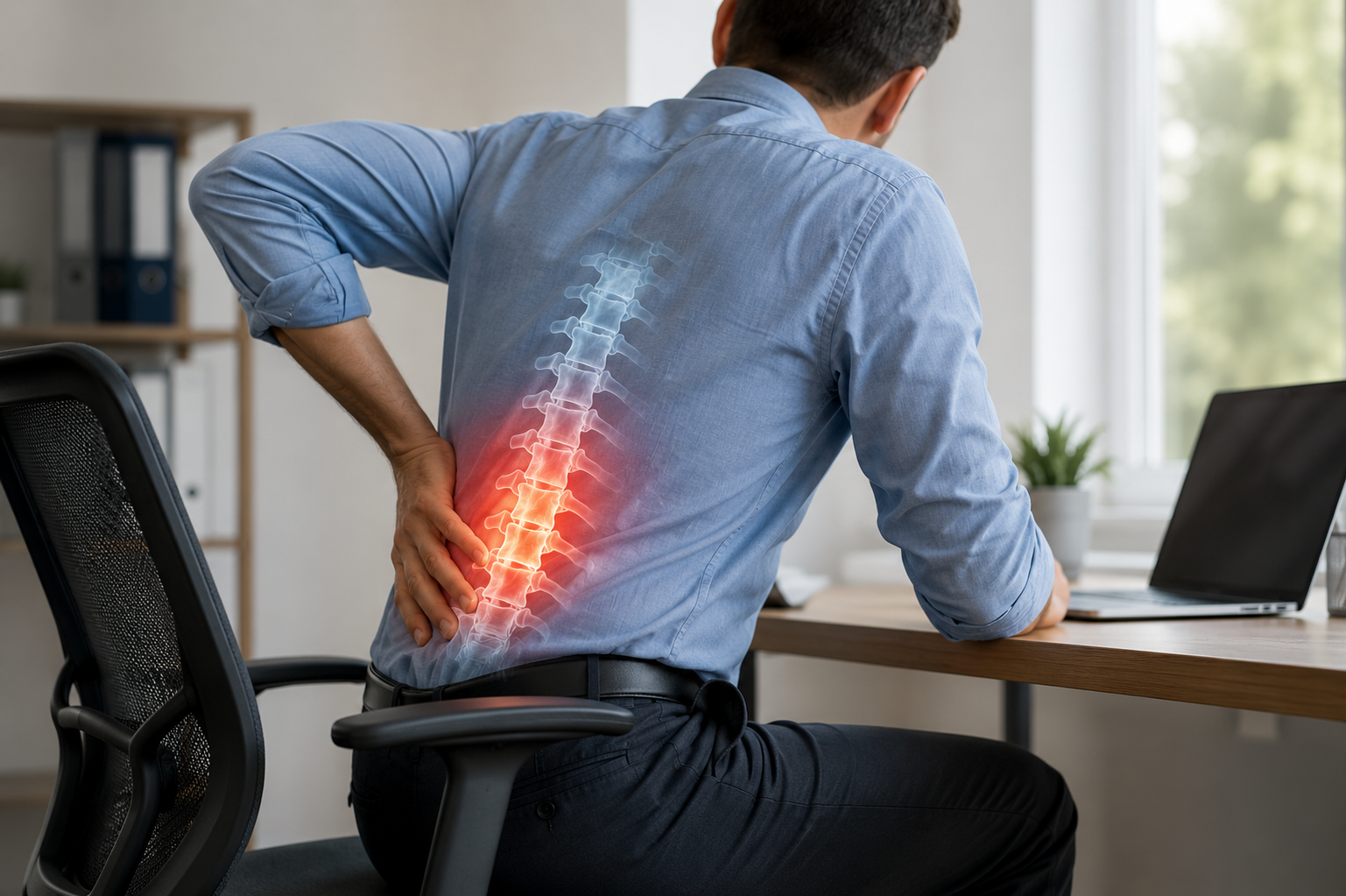
Lower Back Pain After Sitting All Day: Causes, Anatomy, and What Actually Helps
You push back from your chair after a long video call. There is that familiar dull ache, just above the pelvis, that was not there when you sat down three hours ago. You stand, stretch once, and tell yourself it will ease off on the MRT home. It usually does. That is the problem.
When pain reliably disappears with rest, it is easy to treat it as nothing. But that ache is your lumbar spine signaling that the load placed on it today has exceeded what it can absorb without consequence. This guide explains exactly what happens to your lower back when you sit for extended periods, which warning signs to look out for, and how physiotherapy resolves the structural cause rather than the symptom.
Why Sitting Feels Passive But Is Not
Sitting is not a neutral state for the spine. Intradiscal pressure, the compressive force inside the rubbery pads between your lumbar vertebrae, is measurably higher in a seated position than when you are standing or walking. The lumbar spine is designed with a gentle inward curve, called lordosis.
When you sit, especially on a standard office chair, that curve tends to flatten as the pelvis rotates backward. Clinicians call this posterior pelvic tilt: the vertebrae shift their loading pattern, the front of the discs absorbs more compressive force than they are designed for, and the surrounding muscles compensate by maintaining a low-level, fatiguing grip.
Discogenic Pain Versus Facet Joint Pain: Why It Matters
Not all lower back pain from sitting originates from the same structure, and this distinction shapes treatment. Discogenic pain, originating from the intervertebral discs, tends to present as a deep, diffuse ache that worsens after sitting and sometimes refers to a dull pressure in the buttocks. Facet joint pain, arising from the small joints at the back of each vertebra, is typically sharper, more localised, and often eases when you bend slightly forward. Many patients cannot distinguish between the two without a clinical assessment.
The Hip Flexor Connection
Prolonged sitting shortens the hip flexor group, primarily the iliopsoas, the muscle complex that runs from the lumbar vertebrae to the top of the femur. When these muscles tighten, they pull the pelvis into anterior tilt when you stand, which then compresses the lumbar facet joints. This is a common reason why lower back pain from desk work feels worse during the first ten minutes of walking after a long sitting session, not during the sitting itself.
The Singapore context makes this more pronounced. The average desk-bound professional here spends a full workday seated, then adds a 45 to 90-minute MRT commute. That cumulative daily load window is long enough to produce structural changes in soft tissue that a weekend of rest will not fully reverse.
Warning Signs That Deserve Attention
Lower back discomfort from sitting is common. These signals indicate that something beyond routine fatigue may be developing:
- Morning stiffness that takes longer than 10 minutes to ease after getting out of bed.
- Pain that shifts from the lower back into the buttock or the back of the thigh (potential referral from the L4/L5 spinal levels).
- Noticing that stairs feel heavier at the end of a workday than at the start.
- A tendency to lean on one arm of the office chair to offload one side; this is a compensatory movement pattern the body adopts unconsciously.
- Relief when lying flat, but return of pain within 20 minutes of sitting again.
When to seek assessment promptly:
If pain radiates down the leg past the knee or is accompanied by numbness or tingling in the foot, seek a clinical assessment without delay. This may indicate nerve involvement and warrants professional evaluation before it progresses.
Why Rest Alone Does Not Resolve the Underlying Cause
The posterior pelvic tilt, the shortened hip flexors, and the weakened lumbar stabilisers are still present the morning after a full night’s sleep. When you return to your desk, the same loading pattern resumes, and the cycle continues. Over months, the interval between pain episodes typically shortens as the underlying dysfunction compounds.
Patients who manage lower back pain with rest alone for more than six to eight weeks often present with a more complex movement dysfunction than those who seek physiotherapy assessment early. The pain that seemed manageable in the first month becomes harder to address in the fifth.
The 3-Phase Physiotherapy Approach at Rapid Physiocare
With 45 years of combined clinical experience across 6 locations in Singapore, Rapid Physiocare treats lower back pain through a structured, three-phase framework. No two presentations are identical, and no two treatment plans are either. What the phases represent is a clinical logic: address pain first, restore movement second, rebuild strength and resilience third.
| Phase | Goal | What Happens | Timeframe |
| Acute Phase | Pain relief & load management | Manual therapy, postural offloading, and patient education on positions that reduce lumbar disc pressure | Week 1–2 |
| Subacute Phase | Restore lumbar range and hip mobility | Targeted mobility work for the thoracolumbar junction and hip flexor complex; progressive guided movement | Week 2–5 |
| Recovery Phase | Rebuild strength and prevent recurrence | Progressive loading of lumbar stabilisers (transverse abdominis, multifidus); workplace ergonomic review integrated into treatment | Week 5–10 |
What your Phase One looks like depends entirely on how your lumbar spine presents on the day of your first assessment. The timeline above is a clinical guide, not a guarantee.
Three Adjustments You Can Make Before Your First Appointment
These are not substitutes for a clinical assessment. They support comfort while you arrange one. These adjustments address symptoms. They do not resolve the structural cause of recurring lower back pain.
- The 30-minute walk rule: Set a reminder to walk five steps every 30 minutes; not just stand, but walk. Brief walking redistributes intradiscal pressure in a way that standing still does not. This is a meaningful mechanical difference, not a general wellness tip.
- Screen height before lumbar support: If your screen sits below eye level, you are likely rounding forward through the thoracic (mid) spine, which shifts compressive load downward onto the lumbar region. Adjust screen height first. Lumbar cushions become more effective once your upper back posture is corrected.
- Sleeping position if pain is acute: A small rolled towel placed under the lumbar curve when lying on your back, or a pillow between the knees when on your side, can reduce overnight lumbar compression and improve morning comfort.
Ready to resolve your lower back pain?
Book a lower back assessment at any of Rapid Physiocare’s 6 clinic locations across Singapore. Our physiotherapists will identify the specific structures involved, explain what is happening in plain terms, and give you a realistic, customized recovery plan. Book your consultation now.
Frequently Asked Questions
Q1: How long does lower back pain from sitting all day take to recover?
Acute mechanical lower back pain typically responds within 6–10 weeks of structured physiotherapy. Longer-standing cases with movement dysfunction may take longer. A clinical assessment establishes a realistic timeline for your specific presentation.
Q2: Is physiotherapy better than rest for lower back pain?
For mechanical lower back pain caused by prolonged sitting, physiotherapy consistently outperforms rest alone. Rest reduces pain but only temporarily. Physiotherapy addresses the loading pattern, posture mechanics, and muscle imbalances that caused the pain.
Q3: Can sitting all day cause a slipped disc?
Prolonged compressive loading increases lumbar disc stress over time. Whether this progresses to a disc herniation depends on individual disc health and loading patterns. Not all lower back pain from sitting involves the discs. Assessment determines this.
Q4: When should I see a physiotherapist?
If pain returns after every sitting session, lasts more than two weeks, or begins referring into the buttock or thigh, a physiotherapy assessment is warranted. Waiting consistently can lead to a longer recovery once treatment begins.
Q5: Where can I find a physiotherapy clinic for lower back pain in Singapore?
Rapid Physiocare has 6 clinics conveniently located across Singapore. Our physiotherapists assess the specific structures involved and provide a phased recovery plan tailored to your presentation.