Scoliosis in Children and How Physiotherapy Helps Manage Spinal Curvature During Growth
You are straightening your child’s school uniform when you notice it. One shoulder sits higher. The hem hangs longer on one side. The bag strap keeps slipping off the same shoulder. It is easy to dismiss these differences as slouching or posture. However, visible asymmetry can sometimes be a sign of scoliosis and is worth having assessed.
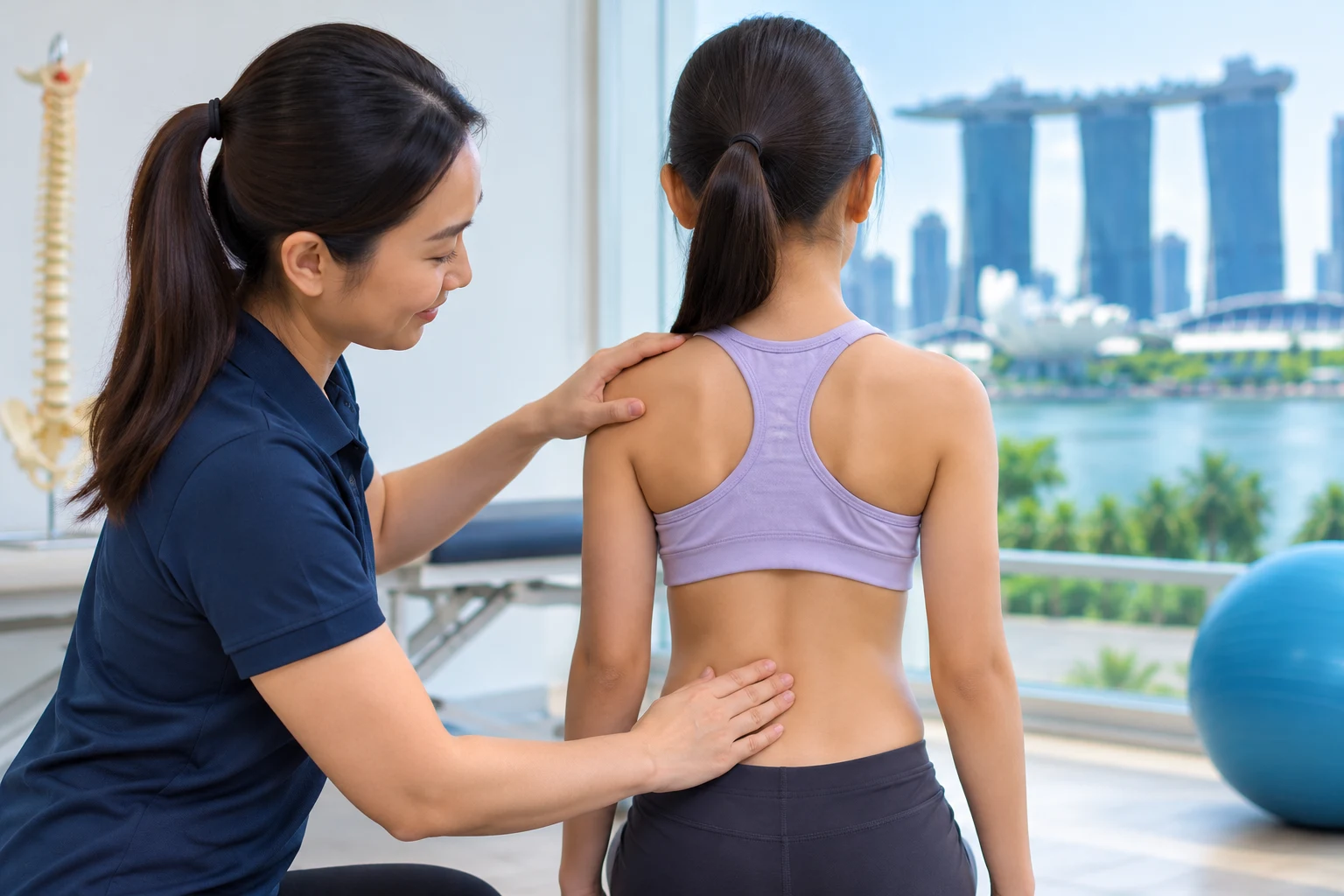
Scoliosis is a three-dimensional spinal deformity involving a sideways curve and, in many cases, rotation of the vertebrae. In children and adolescents, the curve may progress during periods of rapid growth. For a broader understanding of spinal conditions, anatomy and physiotherapy approaches, explore our complete guide to spine health. Physiotherapy may form part of conservative management through scoliosis-specific exercises such as the Schroth method, alongside medical monitoring and other treatment when indicated.
Scoliosis in Children and Why Does the Spine Curve?
When viewed from behind, a typical spine appears relatively straight.Scoliosis is defined by a spinal curve measuring at least 10 degrees on an X-ray using the Cobb angle. Vertebral rotation may also occur, which can make one side of the rib cage or lower back appear more prominent. A physical examination can raise suspicion, but an X-ray is needed to confirm and measure the curve.
Adolescent idiopathic scoliosis (AIS) is the most common type of scoliosis in children and adolescents. “Idiopathic” means the exact cause is unknown. The Scoliosis Research Society estimates it affects 2 to 3 percent of adolescents. Girls are more likely to develop curves that progress to a magnitude requiring treatment. Heavy school bags and poor posture are not considered causes of idiopathic scoliosis. A child with scoliosis may nevertheless experience discomfort or fatigue during prolonged activities.
Congenital scoliosis is associated with differences in how the vertebrae develop before birth. Neuromuscular scoliosis occurs in association with conditions that affect the nerves or muscles, such as cerebral palsy. These types require medical assessment and management tailored to the underlying condition; physiotherapy may be included as part of the wider care plan.
What Signs of Scoliosis Can Parents Spot at Home?
Adolescent idiopathic scoliosis is often painless, so visible changes may be the first sign noticed by parents. Look for:
- One shoulder higher, or one shoulder blade sticking out
- An uneven waistline, or one hip that looks higher
- A head that sits off-center over the pelvis
- A bulge on one side of the ribs when your child bends forward
- Uniform trousers or skirts that hang unevenly
Try the 60-second forward bend check
Ask your child to stand with feet together and bend forwardat the waist, allowing the arms to hang freely. From behind, look for a difference in the height of the ribs or lower back.
This is a simple observation that may highlight asymmetry, but it cannot diagnose scoliosis or measure the spinal curve. If you notice an asymmetry, arrange an assessment with an appropriate healthcare professional rather than relying on repeated home checks.
Why Does Growth Make Spinal Curvature Change?
Scoliosis in children may progress more quickly during periods of rapid growth, particularly around puberty. The timing of the growth spurt varies between children and generally occurs earlier in girls than in boys. Age alone does not determine progression risk; curve size, curve pattern and remaining skeletal growth are also important.
A 15-degree curve in a 10-year-old may have more time to progress because substantial growth may remain. The same curve in a 15-year-old, an older adolescent who is close to skeletal maturity may carry a different risk. Doctors assess remaining growth using several indicators. These may include the Risser sign, which describes the maturity of part of the pelvic bone, alongside age, growth history and other measures of skeletal maturity. A single measurement does not predict an individual child’s outcome. Monitoring intervals are set by the treating team according to the child’s risk.
What Does a Scoliosis Assessment Involve?
A scoliosis assessment considers spinal and trunk alignment, the child’s growth and medical history, and how the curve may affect movement and daily activities. Depending on the child’s presentation, the physiotherapist may review:
- Growth and history: Age, recent height gains, family history, previous X-rays
- Posture: Standing views from the front, back and side
- Trunk rotation: the forward-bend test and, where appropriate, a scoliometer (a hand-held tool that measures the angle of trunk rotation during the forward-bend position; it does not directly measure the spinal curve.)
- Mobility and control: Spinal and ribcage movement, general movement control and relevant muscle strength. The muscles assessed depend on the child’s presentation and functional goals.
- Breathing: how well the chest wall expands on each side
- Daily function: carrying a school bag, swimming, CCA sport
If a clinical assessment raises concern about scoliosis, the child should be referred to a doctor for consideration of appropriate imaging. A standing spinal X-ray is used to confirm the diagnosis and measure the Cobb angle. Follow-up timing depends on curve size, growth remaining and the clinician’s assessment of progression risk; it is not necessarily the same for every child.
Is Scoliosis Treatment Without Surgery Possible?
Many children with scoliosis are managed without surgery. Depending on the curve magnitude, remaining growth and risk of progression, conservative management may include observation, scoliosis-specific physiotherapy treatment, and bracing when indicated. The appropriate plan is determined by the treating medical team.
- Observation for small curves, with regular re-checks
- Physiotherapy for scoliosis, built on scoliosis-specific exercises
- Bracing may be recommended for a child who is still growing and has a curve in a range where progression risk is significant. A commonly used threshold is around 25 degrees, but the decision depends on curve size, skeletal maturity, documented progression and individual circumstances.
Surgery may be considered for severe curves, commonly above 45 to 50 degrees, or when there is significant progression. The International Society for Scoliosis Rehabilitation and Orthopaedic Treatment (SOSORT) lists scoliosis-specific exercises (PSSE) among its recommended conservative approaches. Evidence suggests possible benefits for some outcomes, but certainty varies; exercises should not be presented as a replacement for bracing or surgery when these are indicated.
How Does the Schroth Method Work?
German physiotherapist Katharina Schroth developed it in the 1920s, after living with scoliosis herself.The Schroth method is a form of physiotherapeutic scoliosis-specific exercise (PSSE) that uses individually tailored three-dimensional corrective strategies. Exercises are selected according to the child’s curve pattern and ability and should be taught by a physiotherapist with appropriate Schroth training:
- Elongation: Growing tall through the spine
- Derotation: Reshaping the trunk against the twist of the curve
- Rotational angular breathing: Using a specific breathing pattern, guided by the therapist, to encourage expansion of selected areas of the rib cage and trunk.
- Stabilization: holding the corrected position with muscle control
- Carry-over: using the new posture in daily life
Other physiotherapeutic scoliosis-specific exercise approaches include SEAS and the Lyon method. The choice of approach depends on the child’s curve pattern, age, growth stage, clinical needs and the therapist’s training. A child is taught an individualised programme in the clinic and practises it at home as advised.
How Do Scoliosis Exercises for Children Look Like?
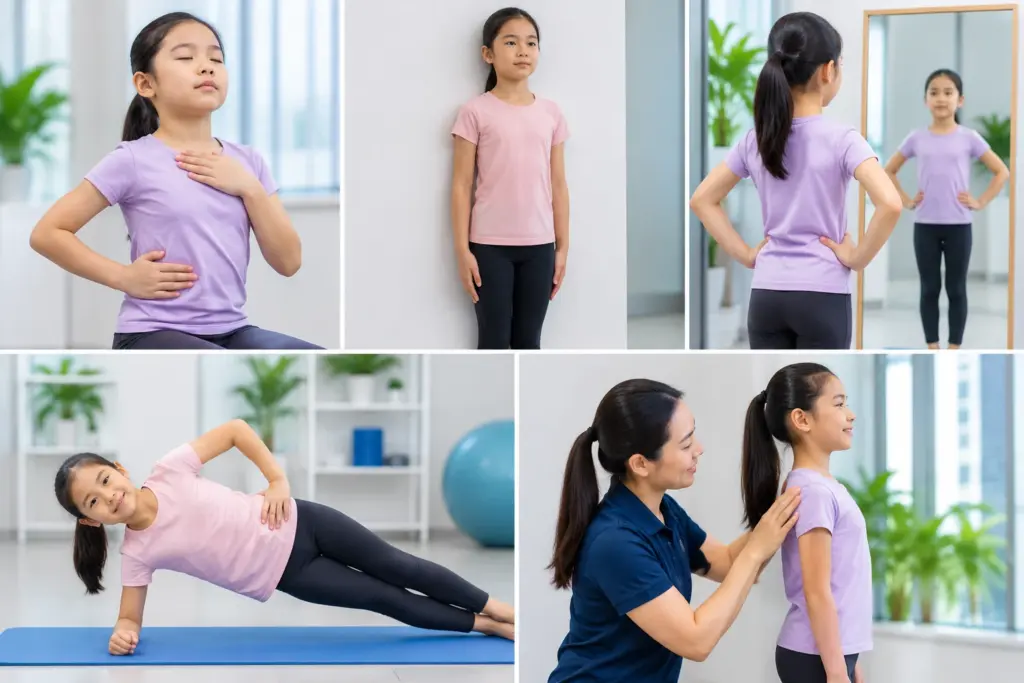
Scoliosis-specific exercises are individualised because curve patterns differ. The examples below illustrate types of exercises that may be used; they are not a routine for every child. Your physiotherapist selects the positions, directions, repetitions and progression after assessment. Home practice should follow the child’s individual instructions, and parents may be taught how to support practice safely.
| Exercise | What the child does | What it builds |
| Rotational angular breathing | Sits or stands in the position selected by the physiotherapist and practises a specific breathing pattern to encourage expansion of the targeted rib-cage area. | Rib cage mobility, breathing, spinal awareness |
| Wall elongation | Stands with back to the wall and lengthens tall, keeping the pelvis level | Postural awareness and active self-correction |
| Mirror pelvic shift | Moves the hips sideways while checking alignment in a mirror | Body awareness,and active movement control |
| Side plank hold | Performs a side plank on the side the physiotherapist selects | Trunk and gluteus medius strength, stability |
| Posture check-in | Practises the individually taught self-correction during a suitable daily activity, with cues from the physiotherapist. | Carry-over of self-correction into daily activities |
When Should a Child See a Scoliosis Specialist?
Your child should be assessed by a doctor with experience in spinal conditions or a physiotherapist with specific training and experience in scoliosis if you notice any of the following:
- The forward bend check shows a rib hump or uneven back
- Shoulders or waist look more uneven than a few months ago
- A close relative has scoliosis and your child is entering a growth spurt
- Back pain keeps returning
Early assessment can help identify scoliosis in growing children, when monitoring and treatment decisions may be important. Seek urgent medical care if your child develops leg numbness or progressive leg weakness, or changes in bladder or bowel control. These symptoms need prompt medical assessment and should not be assumed to be caused by scoliosis.
Where Can Parents Start With Scoliosis in Children?
Start with three steps: Look, Measure, Monitor. Alongside the medical monitoring recommended for your child, understanding daily habits that support long-term spine health can help families encourage healthy movement and activity.
- Look: Notice persistent asymmetry, such as uneven shoulders, waist or rib prominence. A home forward-bend observation may highlight asymmetry but is not a diagnosis.
- Measure: Arrange an assessmentif you notice possible signs of scoliosis. A doctor decides whether an X-ray is needed to confirm and measure the curve.
- Track:Follow the review schedule recommended by your child’s treating team. The interval depends on the curve and the child’s remaining growth.
Rapid Physiocare brings 45 years of combined clinical experience across 6 clinics in Singapore. Every presentation differs, and each treatment plan is built for the individual child. We will explain our findings, whether a doctor’s review may be needed, and the recommended follow-up plan. Book your consultation at your nearest Rapid Physiocare clinic.
Frequently Asked Questions
Can a child’s spinal curve go away on its own?
Small curves can stay stable through growth and some progress. Progression depends on factors such as curve size, curve pattern and remaining growth. Doctors monitor the curve at intervals based on the child’s individual risk. Physiotherapy may provide an individualised exercise programme as part of conservative care, but it does not replace medical monitoring.
Do heavy school bags or poor posture cause scoliosis?
Research has not linked heavy school bags or poor posture to idiopathic scoliosis; habits still shape comfort. A lighter bag carried on both shoulders, regular breaks from long tuition sessions and a supportive desk setup reduce strain on a back that already has a curve.
At what age does scoliosis usually appear?
Adolescent idiopathic scoliosis is typically found between 10 and 18 years, often around the pubertal growth spurt. Earlier forms also exist in infants and younger children, and these need prompt medical review. If you notice persistent asymmetry, arrange an assessment rather than relying on scheduled home checks to screen for scoliosis.
How is scoliosis diagnosed in children?
A physical examination may raise suspicion of scoliosis. A doctor confirms the diagnosis using an appropriate standing spinal X-ray and measures the curve using the Cobb angle; a curve of at least 10 degrees meets the radiographic definition of scoliosis. A forward-bend test and scoliometer may be used during screening, but neither replaces diagnostic imaging.
Can scoliosis physiotherapy straighten my child’s spine?
Physiotherapy cannot guarantee that a child’s spine will become straighter. Scoliosis-specific exercises may help some children improve self-correction, trunk control, function or selected measures of curve progression. However, the evidence is variable and does not support promising a specific reduction in Cobb angle for an individual child. Medical monitoring and bracing or surgery should be considered when indicated.
How long will my child need exercises?
The duration varies according to the child’s curve, growth remaining, treatment plan and response. Some children may continue scoliosis-specific exercises through periods of growth, while others may need a different duration or level of supervision. Your child’s physiotherapist and doctor should agree on the review schedule and when the programme can be modified.
Will my child need a brace?
Your doctor will consider if it is appropriate, based on curve size and the amount of growth remaining. Bracing is commonly considered for moderate curves in growing children, and small curves are usually observed. Physiotherapy may be used alongside bracing as part of the overall care plan; it does not replace the brace when bracing is indicated.
Is the Schroth method suitable for every child?
Schroth-based exercises may be suitable for some children with idiopathic scoliosis, but the approach must be individualised. A physiotherapist with appropriate training assesses the curve pattern, age, growth stage, clinical needs and the child’s ability to learn and practise the exercises. Congenital and neuromuscular scoliosis require medical assessment and a programme tailored to the underlying condition.
Can my child still swim or play sport?
In most cases, children with scoliosis can continue swimming, physical education and other sports. General physical activity supports health and fitness, although sport does not replace scoliosis-specific treatment. Advice may need to be individualised for children with larger curves, pain, a brace or specific medical restrictions. Ask the treating doctor or physiotherapist if a particular activity causes symptoms or there are concerns.
Does scoliosis cause pain or affect breathing in children?
Mild and moderate curves are usually painless. Persistent, severe or night-time back pain should be medically assessed rather than automatically attributed to scoliosis. Very large thoracic curves can affect chest mechanics and, in some cases, lung function, but this is not typical of most children with scoliosis. Schroth breathing exercises aim to improve awareness and control of trunk and rib-cage movement; they should not be described as reversing lung restriction.
References used for the accuracy review
- Scoliosis Research Society – Adolescent Idiopathic Scoliosis: https://www.srs.org/Patients/Conditions/Scoliosis/Idiopathic-Scoliosis
- Scoliosis Research Society – Diagnosing Scoliosis: https://www.srs.org/Patients/Diagnosis-And-Treatment/Diagnosing-Scoliosis
- American Academy of Orthopaedic Surgeons (OrthoInfo) – Idiopathic Scoliosis in Children and Adolescents: https://www.orthoinfo.org/en/diseases–conditions/idiopathic-scoliosis-in-children-and-adolescents
- Cochrane Review (2024) – Therapeutic exercises for idiopathic scoliosis in adolescents: https://pmc.ncbi.nlm.nih.gov/articles/PMC10900302/
- 2025 review – Physiotherapy management of adolescent idiopathic scoliosis: https://doi.org/10.1016/j.jphys.2025.09.001
- 2025 systematic review – Effects of physiotherapeutic scoliosis-specific exercise on adolescent idiopathic scoliosis Cobb angle: https://pubmed.ncbi.nlm.nih.gov/40223832/
- US Preventive Services Task Force – Adolescent Idiopathic Scoliosis: Screening: https://www.uspreventiveservicestaskforce.org/uspstf/recommendation/adolescent-idiopathic-scoliosis-screening