
Shockwave Therapy for Persistent Tendon Pain: When Is It Appropriate?
Shockwave physiotherapy may help when tendon pain has lasted for months and a guided exercise programme has stalled. A physiotherapist confirms the diagnosis first. Shockwave therapy then sits inside a progressive loading plan. Suitability depends on the tendon, your symptoms and your clinical assessment.
The first steps out of bed stepping on a bruise. By the time you reach the MRT station, only for discomfort to return after a day at your desk and a long commute home. This pattern can occur with plantar heel pain, including plantar fasciopathy, although other conditions can cause similar symptoms. Stretching or resting briefly may ease symptoms, but persistent pain deserves an assessment to identify the likely source and plan an appropriate return to loading.
What Is Tendinopathy, and How Does It Differ From Tendon Inflammation?
Tendinopathy is the preferred term for persistent tendon pain and reduced function related to loading. The older term ‘tendinitis’ suggests inflammation, but persistent tendon pain is not simply a short-term inflammatory reaction after a sudden overload. The underlying tendon changes can be complex, and symptoms may be influenced by training load, recovery, health and other factors. Using the term tendinopathy helps describe the clinical problem without assuming one specific tissue process.
Why Does Tendon Pain Keep Coming Back?
Tendon pain can persist or recur when the demands placed on the tendon exceed its current capacity or when the load is increased faster than the person can adapt. This is not always due to one identifiable cause. Factors may include:
- A sudden jump in running, badminton or gym volume
- Repetitive loading, such as hours of mouse work or carrying groceries up from the wet market
- Weak calves, hips or forearm muscles that make the tendon work harder
- Returning to full activity the week the pain eases
- Medical conditions and some medicines that affect tendon health
Which Tendon Conditions Respond to Physiotherapy?
Achilles Tendinopathy
The Achilles tendon connects the calf muscles to the heel bone. Achilles tendinopathy commonly causes pain, tenderness or stiffness along the tendon, often with activity such as running, jumping or repeated heel raises. Understanding the causes, symptoms and management options can help you make informed decisions about Achilles tendon pain and physiotherapy treatment. Management usually centres on progressive calf strengthening and load modification, with the exercise plan tailored to whether symptoms are in the midportion or near the heel insertion. Other factors may be assessed when relevant, but hip weakness or foot mechanics should not automatically be assumed to be the cause.
Plantar Fasciitis
The plantar fascia is a thick band of connective tissue along the sole of the foot. It is ligament-like, yet it responds to similar loading principles. Plantar fasciopathy (often called plantar fasciitis) can cause pain around the heel, commonly with the first steps after rest or after prolonged standing and walking. Treatment usually includes education, load modification and targeted exercises for the foot and calf. You can also explore different plantar fasciitis treatment options to understand the available approaches to managing persistent heel pain. Shockwave or pressure-wave therapy may be considered for some people with persistent plantar heel pain after an appropriate conservative programme, but it is not suitable or necessary for everyone.
Tennis Elbow
Tennis elbow affects the forearm extensor tendons at the outer elbow. It can affect people who play racket sports as well as people whose work or hobbies involve repeated gripping, lifting or wrist movements. Treatment commonly includes education, activity modification and progressive strengthening of the wrist and forearm. Shockwave or pressure-wave therapy may be considered in selected persistent cases, although the evidence and recommendations vary.
How Does a Physiotherapist Assess Tendon Pain?
An assessment considers the likely structure involved, the pattern of symptoms, relevant health and activity history, and how the area responds to movement and loading. Rapid Physiocare’s physiotherapists bring 45 years of combined clinical experience across 6 clinics in Singapore. Every presentation differs, so every plan is written after the findings, with your work and sport in mind. The physiotherapist builds that picture in five steps:
- History: when the pain began, what changed in your training or work, and how it behaves through the day.
- Movement and clinical tests: assessing symptom behaviour, strength, movement and the structures that may be contributing to the presentation.
- Load-tolerance tests: These help assess symptoms and functional capacity; they are not a direct measurement of tendon strength or tissue integrity.
- Relevant movement and strength screening: the physiotherapist may assess nearby joints, muscle strength and movement patterns when these are relevant to the person’s symptoms and activity demands.
- Other possible causes: considering whether medical review or imaging is appropriate when the history or examination suggests another diagnosis, significant injury or a feature that needs further investigation.
Which Exercises Help Painful Tendon?
Progressive exercise is a central part of managing many tendinopathies. The programme is tailored to the tendon, symptom irritability, current strength and activity goals. Depending on the condition, a physiotherapist may use:
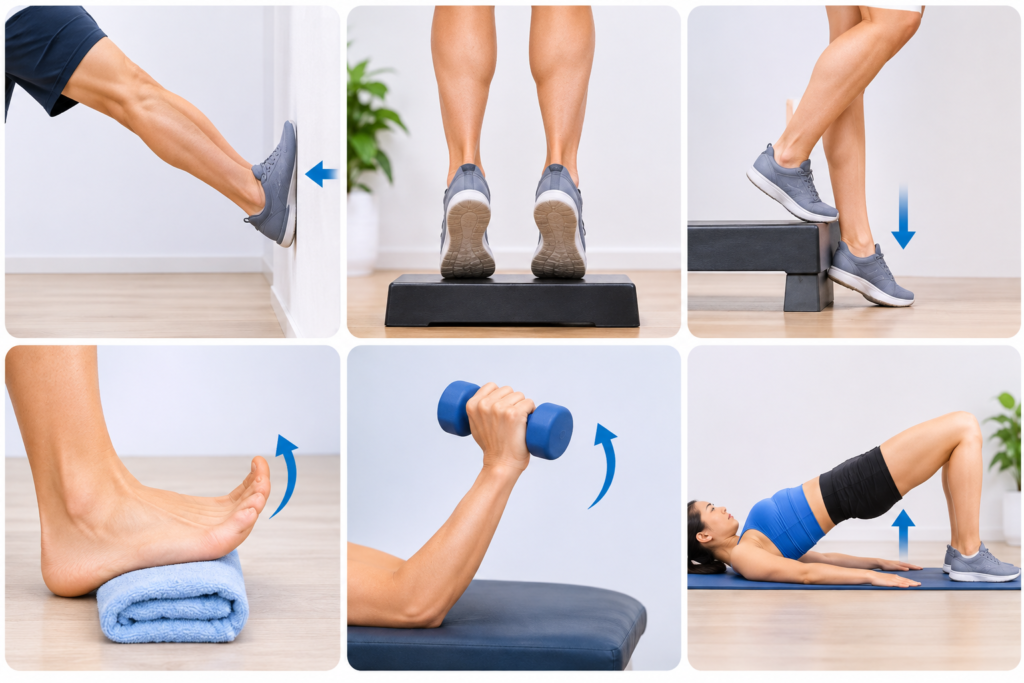
Isometric exercises:
Holding a muscle contraction without visible joint movement. They may be useful in some programmes, but pain relief is variable and they are not essential or effective for everyone.
Calf strengthening:
Exercises may progress from bilateral to single-leg heel raises and then to added resistance, depending on symptoms, strength and the stage of rehabilitation.
Eccentric exercises:
Movements that emphasise the muscle-tendon unit while it lengthens, such as a controlled heel-lowering exercise. Eccentric work is one option; current rehabilitation may also use other forms of progressive resistance training.
Plantar fascia-specific exercises:
A physiotherapist may prescribe targeted foot and calf exercises, such as a heel raise with the toes supported in extension, when appropriate for the person’s symptoms and capacity.
Wrist and forearm strengthening:
Progressive wrist-extension and grip exercises may be used for lateral elbow tendinopathy. The resistance and exercise type are adjusted to symptoms and functional goals.
Targeted strengthening:
Hip or other regional strengthening may be included when assessment identifies a relevant strength or functional goal. It should not be prescribed on the assumption that gluteus medius weakness caused the tendon problem.
Sets, repetitions and weights vary by tendon and pain response, so your physiotherapist will tailor the programme. Some discomfort during exercise may be acceptable, but the response should be monitored during the session and over the following 24 hours.Sharp pain, or stiffness that worsens the next morning, usually means the load or exercise may need to be adjusted.
What Is Extracorporeal Shockwave Therapy (ESWT)?
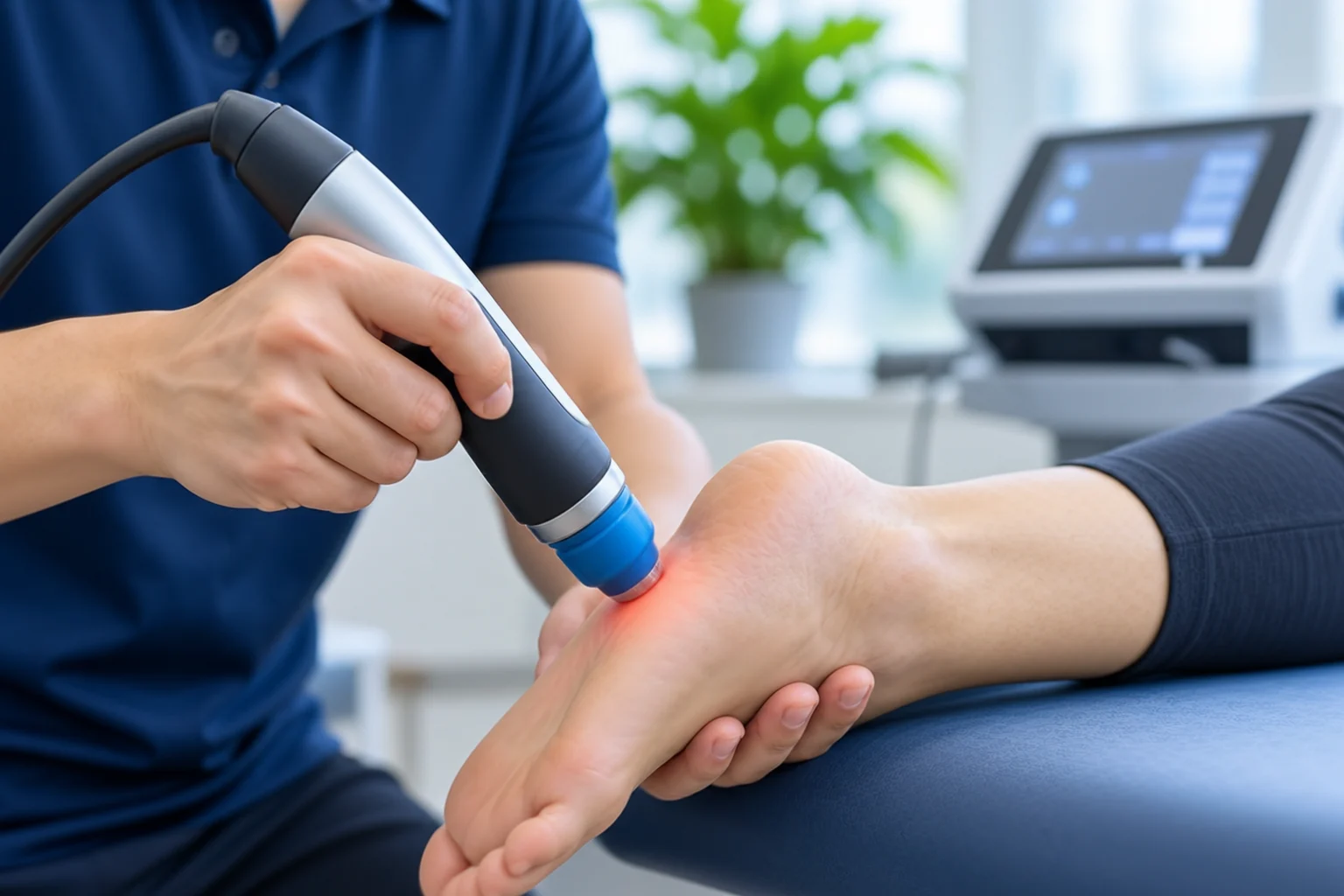
Extracorporeal shockwave therapy delivers acoustic pressure waves through the skin to a targeted area, using a handheld applicator. “Extracorporeal” means outside the body. Researchers still study how it works. For a closer look at the treatment approach, its applications and what patients can expect, explore our shockwave therapy treatment service. Proposed mechanisms include effects on pain signalling and local tissue responses, but these should not be presented as proven tissue repair.
During treatment, coupling gel is applied and the clinician moves the applicator over the selected treatment area. The sensation can range from uncomfortable to painful, and intensity is adjusted according to the device, treatment protocol and the person’s tolerance. Temporary soreness, redness, swelling or bruising can occur. Treatment schedules vary by condition and protocol; some consensus recommendations describe three to five sessions spaced one to two weeks apart, but this is not a universal schedule.
When Is Shockwave Physiotherapy Worth Considering for Tendonitis or Tendinopathy?
Shockwave therapy for tendinopathy suits some tendon conditions better than others, but the evidence differs by diagnosis and by treatment type. A physiotherapist may consider it when:
- The diagnosis is clear after assessment
- Symptoms lasted for months despite an appropriately tailored rehabilitation programme
- Symptoms or functional limitations remain significant despite appropriate load modification, and the clinician has considered other management options.
- A clinical screening has considered relevant contraindications, precautions, medications, implants and the treatment area.
Shockwave therapy is not appropriate for every person. Screening should consider pregnancy, active infection or malignancy in or near the treatment field, bleeding or clotting disorders, anticoagulant use, implanted electronic devices, recent corticosteroid injection, skeletal immaturity near the treatment area, and nearby sensitive structures such as lung tissue or major nerves. The relevance of each factor depends on the treatment modality, energy level and anatomical site, so the clinician should follow current guidance and the device manufacturer’s instructions.
How Does Shockwave Physiotherapy Fit Into Your Exercise Plan?
Where appropriate, shockwave or pressure-wave therapy may be used alongside a progressive rehabilitation programme. It should not replace exercise, education or load management. The aim of rehabilitation is to improve strength and tolerance for the activities that matter to you. Whether shockwave adds meaningful benefit depends on the specific condition; evidence is mixed and, for Achilles tendinopathy, recent evidence does not support routine use. The plan should be reviewed according to symptoms and function.
When Should You Get Persistent Tendon Pain Assessed?
Book an assessment if:
- Pain has lasted more than a few weeks despite reasonable activity modification, or it is affecting your usual activities.
- First-step or morning pain returns daily
- Pain limits walking, typing, lifting or sport
- You notice swelling or a lump along the tendon
Seek urgent medical care if you experiencea sudden snap or pop with weakness, loss of function or difficulty pushing off the foot, as these may indicate a tendon rupture. A hot, red, swollen area with fever also needs prompt review.
Suggested replacement: Seek urgent medical assessment if you experience a sudden snap or pop with marked pain, weakness, loss of function or difficulty pushing off the foot, as these may indicate a tendon rupture. A hot, red, swollen area with fever also needs prompt medical review.
Accuracy note: Useful red flags. Retain and clarify the functional signs of possible rupture.
Rapid Physiocare provides tendon pain treatment across 6 clinics in Singapore, backed by 45 years of combined clinical experience. Ask your physiotherapist whether shockwave therapyis appropriate for your specific condition. Recovery timelines vary, and early assessment can help clarify the diagnosis and plan the next steps.
Book a consultation to have your symptoms assessed, discuss appropriate treatment options and agree on a rehabilitation plan. Your physiotherapist can explain whether shockwave therapy is suitable for your condition.
Frequently Asked Questions
Is Shockwave Therapy Painful?
Shockwave therapy may feel uncomfortable over the targeted area, and many people describe it as intense but brief. Temporary soreness, redness, swelling or bruising may occur.Your physiotherapist should explain andadjusts the intensity to your tolerance.
How Many ESWT Treatment Sessions Will I Need?
The number of sessionsdepends on the diagnosis, treatment type, protocol and response. You may be recommendedfor three to five sessions spaced one to two weeks apart for selected tendon and fascia conditions, but this is not a fixed course for every person. Your physiotherapist reviews progress throughout, and exercises continue alongside.
How Long Does Tendon Recovery Take With Shockwave Therapy?
Tendon recovery maytake weeks to months, according to the condition, symptom duration, severity, health factors, activity demands and response to rehabilitation. Shockwave sessions are only one possible part of care, and progressive loading and activity modification remain important.
Can Shockwave Physiotherapy Fix Tendon Pain Permanently?
Shockwave physiotherapy supports recovery, and results vary between people and tendons, but it does not guarantee permanent relief. Lasting relief depends on correcting the overload behind the pain through progressive loading, strength work and activity pacing.Symptoms can recur, and persistent or changing pain may need reassessment.
Does Plantar Fasciitis Shockwave Therapy Work?
Some clinical guidelines suggest it helps some people with persistent heel pain, but results vary. It is usually considered after guided loading and strengthening have failed to settle symptoms. Your physiotherapist should assess your diagnosis and discuss the likely benefits, limitations and alternatives.
Can Office Workers Get Tennis Elbow, and Does Tennis Elbow Shockwave Therapy Help?
Yes. Lateral elbow tendinopathy can affect people who play racket sports and people whose work or hobbies involve repeated gripping, lifting or wrist movements. Typing and mouse use may contribute to symptoms for some people, but they are not automatically the cause. Shockwave therapy may be discussed for persistent cases after assessment and a suitable exercise-based programme; evidence varies.
Can Shockwave Therapy Treat Tendon Pain in the Shoulder, Hip or Knee?
Shockwave therapy is also used for tendons in the shoulder, hip and knee, but evidence differs by diagnosis and treatment protocol. Tendinopathy treatment in these areas follows the same loading principles. Your physiotherapist confirms the diagnosis before recommending shockwave.
Do I Need a Scan Before ESWT Treatment?
Many tendinopathies can be assessed clinically using the history and physical examination; imaging is not routinely required in every case. Ultrasound, X-ray or MRI may be considered when the diagnosis is uncertain, a significant tear or another condition is suspected, or imaging would change management. The decision is made by the appropriate treating clinician.
Who Should Avoid ESWT?
Whether shockwave therapy is appropriate depends on the treatment modality, energy, site and individual health factors. Important screening considerations may include pregnancy, bleeding or clotting disorders, anticoagulant medication, active infection or malignancy near the treatment field, implanted electronic devices, recent corticosteroid injections and skeletal immaturity near the treatment site. Some are contraindications in particular circumstances; others require an individual risk assessment. Your physiotherapist should check the device-specific guidance before treatment.
Should I Rest Completely Until the Tendon Stops Hurting?
Complete rest is not usually recommended for most persistent tendinopathies.A physiotherapist may advises adjusting activity to a level the tendon tolerates, while loading exercises continue. The appropriate load depends on the diagnosis and symptom response. Do not push through severe or worsening pain, and seek reassessment if symptoms deteriorate.
References used for the accuracy review:
• ICON 2019 International Scientific Tendinopathy Symposium Consensus: Clinical Terminology (tendinopathy is preferred terminology for persistent tendon pain related to mechanical loading): https://bjsm.bmj.com/content/early/2019/08/08/bjsports-2019-100885
• 2025 International modified Delphi study on shockwave and pressure-wave therapy in sports medicine (modality distinctions, indications, treatment parameters and contraindications): https://bjsm.bmj.com/content/59/18/1287
• 2026 systematic review and meta-analysis of shockwave therapy for midportion and insertional Achilles tendinopathy (nine RCTs, 557 participants; no clinically meaningful overall benefit): https://pubmed.ncbi.nlm.nih.gov/42063301/
• International Society for Medical Shockwave Treatment (ISMST) guidelines: contraindications and adverse effects: https://shockwavetherapy.org/wp-content/uploads/2024/01/ISMST-Guidelines-for-ESWT-_-engl-20240103.pdf
• Royal National Orthopaedic Hospital NHS – Patient guide to radial extracorporeal shockwave therapy: https://www.rnoh.nhs.uk/patients-and-visitors/patient-information-guides/radial-extracorporeal-shockwave-therapy-eswt
• Best practices for extracorporeal shockwave therapy in musculoskeletal medicine: clinical application and training considerations: https://pmc.ncbi.nlm.nih.gov/articles/PMC9321712/