
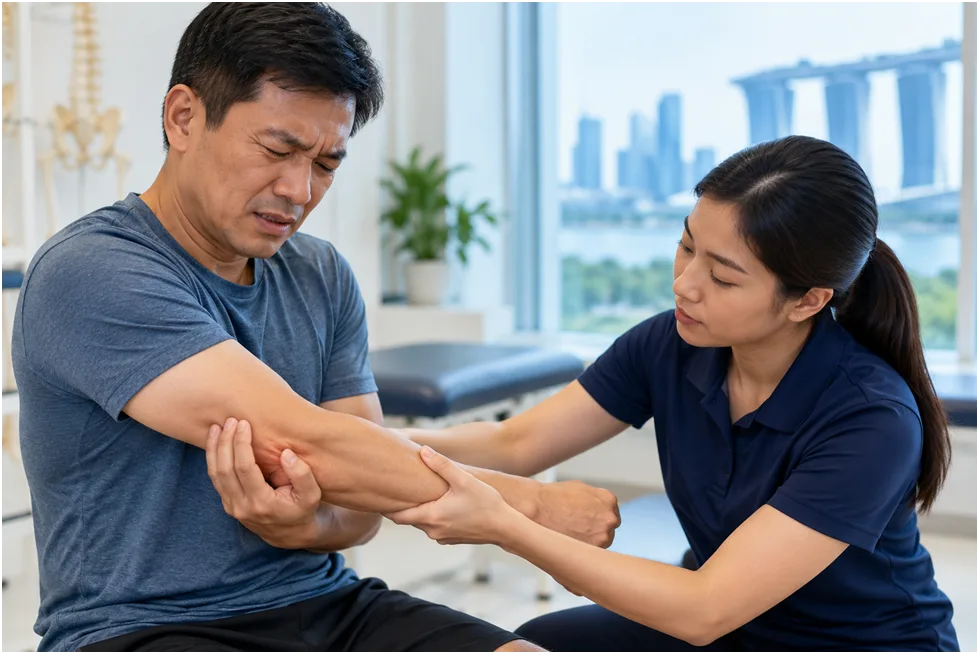
What Are the Symptoms of Tennis Elbow, and How Is It Treated?
When lifting your mug, you suddenly experienced a sharp line of pain flashes along the outside of your elbow. You try to shake it off. An hour later, the pain returns as you turn a door handle. That twinge is a signal. Left alone, that twinge can grow into a weak grip and a sore forearm.
These are typically symptoms of tennis elbow. They include pain on the bony bump outside the elbow, tenderness when you press, and a weaker grip. The condition, medically called lateral epicondylitis, is an overload problem in the forearm tendon. When it comes to treatment, physiotherapy treats it in three phases: pain relief, restored movement, then strength.
Tennis Elbow Symptoms
Symptoms usually build slowly.
- Pain over the bony bump on the outer elbow (the lateral epicondyle)
- A burning or aching feeling that can travel down the forearm
- Pain when you grip an object, shake hands, or turn a key
- A weaker grip, such as dropping cups or struggling with a jar lid
- Pain when you lift your wrist against resistance, like using a mouse for hours
The pain eases at rest but it will return when you move to the next task.
When Do Symptoms Need Urgent Attention?
See a doctor promptly if your elbow swells suddenly after a fall, looks deformed, or turns hot and red with a fever. Numbness spreading into your hand also requires immediate medical review.
Why Does the Outside Elbow Hurt?
Several forearm muscles lift your wrist and straighten your fingers. They share a tendon that attaches at the lateral epicondyle. One of them, the extensor carpi radialis brevis, usually takes the heaviest strain.
Repeated gripping loads that tendon faster than it can adapt, and its fibres become disorganised and painful. The name suggests inflammation. Research shows the changes are mainly degenerative, so clinicians also use the term tendinopathy (a painful, overloaded tendon).
What Are the Common Tennis Elbow Causes?
Tennis elbow causes go well beyond the racquet. Typical triggers here include:
- Long hours on a keyboard and mouse with the wrist held extended
- Playing badminton, tennis, or squash after a long break
- Heavy gym work such as deadlifts and pull-ups
- Carrying a laptop bag or heavy groceries
The common thread is a sudden rise in gripping load. And this condition appears often in adults in their 30s to 50s. Repetitive movements and prolonged work activities can also contribute to other forms of elbow pain during everyday activities, making activity modification important.
Is It Tennis Elbow or Something Else?
Outer elbow pain can also come from a pinched nerve in the neck, radial tunnel syndrome (an irritated nerve in the forearm), or the elbow joint itself. Other conditions, including lateral and medial elbow injuries, can also cause discomfort around the joint. Each needs a different plan, so a hands-on assessment matters.
What Happens at a Tennis Elbow Assessment?
A thorough assessment usually covers four checks:
Patient History: Understanding when the pain started, which activities aggravate it, and any recent changes in work demands, daily activities or training routines.
Palpation: Gently applying pressure around the tendon attachment to identify the precise area of tenderness.
Resisted Movement Testing: Assessing pain and tendon response by testing wrist extension and middle finger extension against resistance.
Grip Strength & Joint Screening: Comparing grip strength between both hands and assessing the neck, shoulder and surrounding joints to identify any contributing factors.
Can Tennis Elbow Be Treated Without Surgery?
Yes. Surgery is considered only after several months of well-run conservative care have failed to help. Physiotherapy is the first step for tennis elbow treatment.
What About Injections and Other Options?
Corticosteroid injections can ease pain for a few weeks. Research shows higher recurrence at 6 to 12 months than with a wait-and-see approach, so the benefit fades. Discuss any injection with your doctor and keep a loading programme running alongside any tennis elbow treatment.
What Does Tennis Elbow Physiotherapy Involve?
Calming the pain:
Tennis elbow physiotherapy begins by identifying and modifying activities that aggravate the affected tendon. Manual therapy may help provide short-term pain relief, and gentle isometric exercises can reduce pain too. A structured tennis elbow treatment programme. can also include progressive strengthening to restore tendon capacity and improve grip function. A tennis elbow brace may offer temporary help during the first weeks. Keep the arm moving, because full rest lets the tendon weaken further.
Restoring movement:
Treatment focuses on improving comfortable wrist and elbow movement, addressing muscle tightness where relevant, and gradually introducing controlled strengthening exercises. Your physiotherapist may also assess your shoulder, neck and overall upper-limb movement to identify contributing factors that could affect how your arm handles everyday activities.
Strength and prevention:
As symptoms improve, rehabilitation progresses towards strengthening the wrist extensors, forearm muscles, and grip to meet the demands of daily activities, work or sports. Your physiotherapist may also review your racquet grip, workstation ergonomics and lifting techniques to help manage tendon loading and reduce the risk of recurring symptoms.
Tennis Elbow Recovery Time
Tennis elbow recovery time depends on how long symptoms have been present and how much load the tendon takes each day. Recent, mild cases often improve within 6 to 12 weeks. Long-standing cases can take 6 months or more.
Milestones tell you more than a calendar:
Pain settles: Lifting a kettle stops triggering a sharp twinge. This usually comes first.
Movement returns: You straighten the elbow and bend the wrist fully, and a workday at the keyboard feels comfortable.
Strength rebuilds: You carry your bag or play a game of badminton, and the ache fades by the next morning.
The tendon adapts slowly, and pain improvement does not always mean the tendon has fully recovered. At week four, the pain may fade while the tendon may still need progressive strengthening to rebuild its load tolerance. Stopping rehabilitation too early or returning to demanding activities too quickly may increase the risk of symptoms returning.Your physiotherapist will monitor your progress against your assessment and adjust your rehabilitation timeline to suit your recovery.
When Is It Safe to Return to Sport?
Recurrence often follows a rushed comeback. Work through these steps in order:
- Complete a full workday without forearm pain.
- Match your grip strength to the other arm.
- Finish your loading exercises with no flare-up the next day.
- Return at half your usual volume, then add a little each week.
- Review your racquet grip size or bar grip before the first session.
Do Tennis Elbow Exercises and a Brace Help?
Tennis elbow exercises work because tendons respond to graded load. Two common starting points:
- Isometric wrist extension: Rest your forearm on a table, palm down. Lift the wrist gently and hold for 30 to 45 seconds. Repeat a few times.
- Eccentric wrist extension: Use your other hand to lift the wrist, then lower it slowly with a light weight.
Keep pain at a mild level during both. A simple check: the ache should settle by the next morning. If it lingers, the load was too high. Have your physiotherapist check your technique first, since the right load depends on your tendon.
A tennis elbow brace (a strap worn just below the elbow) can reduce load on the tendon during gripping tasks. It gives short-term comfort, and evidence for long-term benefit is mixed. Use it as support during activity while exercises rebuild the tendon.
How Rapid Physiocare Treat Tennis Elbow?
Effective tennis elbow treatment starts with an accurate diagnosis. Our team brings extensive combined clinical experience in Singapore. Since each presentation differs, your treatment plan begins with a thorough, individualized assessment.
Don’t let persistent elbow pain limit your daily activities. If your symptoms have lasted more than a few weeks, book your consultation to start your first step towards recovery.
Frequently Asked Questions
Can Tennis Elbow Go Away on Its Own?
Mild cases can settle over several months once the load on the tendon drops. A short break from heavy gripping, plus small changes to how you work or train, is sometimes enough. Flare-ups return often while the tendon stays weak, because daily tasks keep loading a tendon that has not fully rebuilt its strength.
How Long Does Tennis Elbow Take to Heal?
Recent, mild cases often improve within 6 to 12 weeks. Long-standing cases can take 6 months or more. Tennis elbow recovery time depends on how long symptoms have been present, how much gripping your week demands, and how consistently you follow your loading plan. Your physiotherapist can give a clearer estimate after an assessment.
Should I Rest or Keep Exercising With Tennis Elbow?
Rest calms the pain, but the tendon gains strength only when it is loaded again in steps. Avoid heavy gripping and repeated wrist work during a flare-up. Then start graded tennis elbow exercises, keeping pain at a mild level. Your physiotherapist sets the starting load and progresses it as the tendon adapts.
What Is the Difference Between Tennis Elbow and Golfer’s Elbow?
Tennis elbow affects the tendon on the outer elbow and hurts when you grip or lift the wrist. Golfer’s elbow (medial epicondylitis) affects the tendon on the inner elbow and hurts when you bend the wrist or grip tightly. Both can occur in the same person, so a proper assessment confirms which tendon is involved.
Is a Tennis Elbow Brace Worth Using?
A brace can ease gripping tasks in the early weeks. It is a strap worn just below the elbow that spreads load away from the sore tendon. Evidence for long-term benefit is mixed, so pair it with a graded exercise plan from your physiotherapist. Use it for demanding tasks, and build tendon strength alongside.
How Many Physiotherapy Sessions Will I Need?
The number depends on how long you have had symptoms, how irritable the tendon is, and your daily demands. A desk worker with recent pain needs a different plan from a badminton player with symptoms lasting months. Your assessment sets the plan, and your progress through the three phases adjusts it.
Can I Keep Working With Tennis Elbow?
Usually yes, with changes. Keep your forearms supported, rest your wrists in a straight position, and take short breaks from typing and mouse use. Carry your bag on the other arm for a while. Avoid pushing through sharp pain, and speak to a physiotherapist if work tasks keep triggering symptoms.
Do I Need a Scan for Tennis Elbow?
Lateral epicondylitis is usually diagnosed from your history and a physical examination. Your clinician presses the tendon attachment and tests your wrist and grip against resistance. A scan is considered if symptoms look atypical, if you had a significant injury, or if progress stalls despite a well-run plan.
When Is Surgery Considered for Tennis Elbow?
Surgery is a late option, usually after 6 to 12 months of conservative care without improvement. Doctors first confirm the diagnosis and check that the loading plan was followed properly. Many people recover well before that point, which is why physiotherapy is the first step.
How Can I Stop Tennis Elbow From Coming Back?
Build forearm and grip strength so the tendon can handle your daily load. Gradually increase training or work demands in small steps, and review your racquet grip size, desk set-up, and lifting technique. Keep a short maintenance routine once pain settles, because stopping early is a common reason symptoms return.