Knee Pain When Going Down the Stairs: Causes & Treatment
You take the stairs down two flights instead of the lift, same as always. Halfway down, there it is: a sharp catch under the kneecap, gone by the time you reach the bottom. You shrug it off. By the third or fourth time it keeps happening in a week, you start taking the lift instead. Descending stairs is one of the most demanding things you ask your knee to do, more demanding than climbing up. If pain shows up specifically on the way down, your knee might be under strain. This guide walks through why you might be experiencing knee pain when going down the stairs, the signs and symptoms and what your recovery will look like.
The Problem: Why It Hurts Going Down the Stairs More
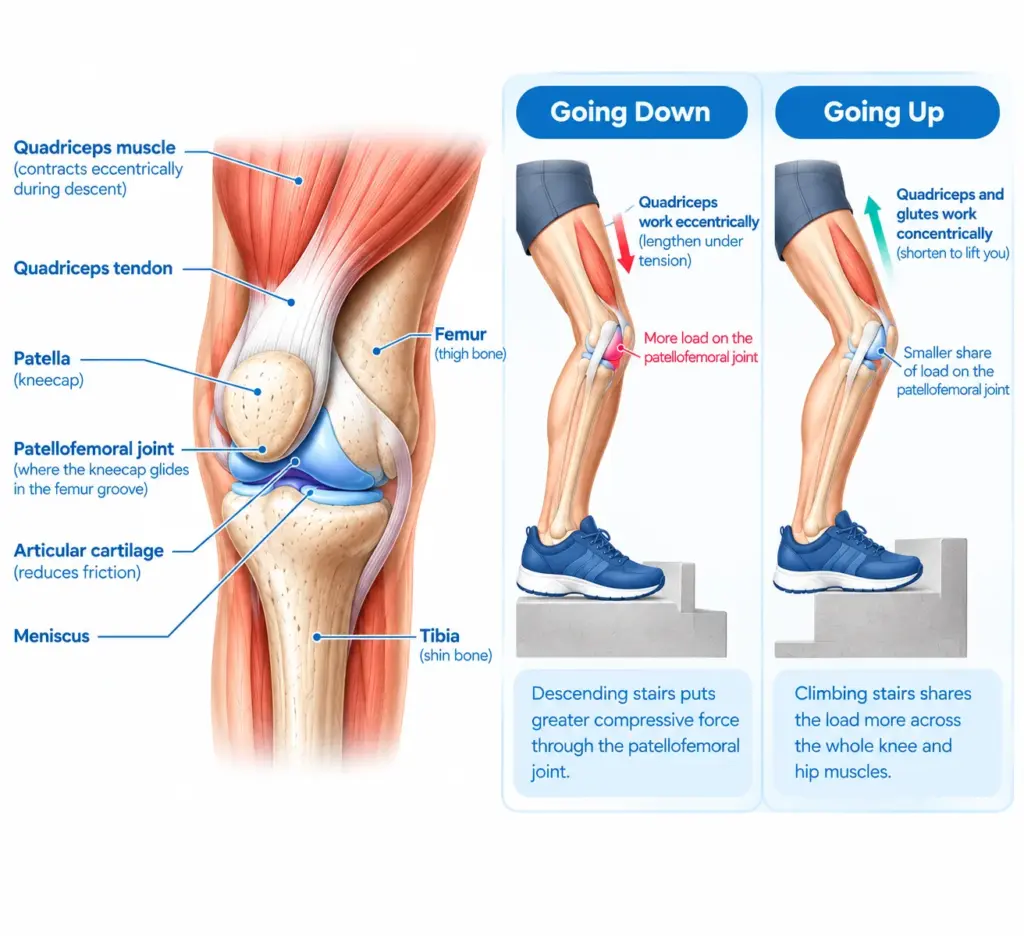 Going down the stairs loads the knee differently. On the descent, your quadriceps work eccentrically: the muscle lengthens under tension to control your body weight as it lowers, rather than shortening to lift you. This eccentric control routes a large share of the load straight through the patellofemoral joint, where the kneecap glides in a groove at the front of the thigh bone (femur).
Climbing is a different story. It’s primarily a concentric task: your quadriceps and glutes shorten to push you upward, and the patellofemoral joint, while still loaded, handles a comparatively smaller share of the total force. This is why patients frequently tell us, “Going up the stairs up is fine, but going down the stairs is the problem.”
Under normal conditions, the patellofemoral joint handles this eccentric load without complaint. But if the kneecap isn’t tracking smoothly through the groove, or if the cartilage behind it is irritated or thinning, the added compressive force on the way down is often enough to trigger pain that climbing the same flight doesn’t produce.
Desk-bound routines can make this worse over time. Long hours seated at a desk, followed by a rushed walk to the MRT or a flight of steps at a multi-storey carpark, mean the muscles that should be stabilizing the kneecap (particularly the quadriceps and gluteus medius, a hip muscle that controls how your thigh rotates and tracks) often go underused during the day and then get a sudden load absorption.
The Cause
No two presentations are identical, and treatment follows no generic protocol. That said, most causes of knee pain on stairs trace back to one of a handful of underlying issues.
Patellofemoral pain syndrome (runner’s knee)
Often called runner’s knee, it is one of the common causes of pain that worsens specifically on stairs, squats, and after long periods sitting with the knee bent. It develops when the kneecap tracks slightly off-center in its groove, increasing friction and compressive load with every step down. Weakness in the hip and thigh muscles is usually a contributing factor, not just the kneecap itself.
This is the gradual wearing of the cartilage that cushions the knee joint. Stairs, and descending stairs in particular, place high compressive force through the joint surfaces, which is why arthritic knees often flare specifically on this movement even when walking on flat ground feels manageable. Morning stiffness and gradual onset over months or years, rather than a single incident, point toward this cause.
Patellar or quadriceps tendon irritation
The patellar tendon connects the kneecap to the shin bone, and the quadriceps tendon connects the thigh muscle to the top of the kneecap. Both can develop tendonitis through repetitive loading, particularly in people who’ve recently increased stair use, hill walking, or training volume. The pain tends to sit at a specific point just above or below the kneecap rather than spreading through the joint.
Meniscus irritation
The menisci are two C-shaped pieces of cartilage that cushion the knee joint between the thigh bone and shin bone. A meniscus tear, or lesser irritation without a full tear, sometimes results from a single twisting movement and sometimes from gradual wear. Either can produce pain, catching, or a sense of instability that’s noticeably worse when the knee bears weight through a bent position, which descending stairs demands.
Muscle weakness and loading pattern faults
Not every cause is structural. Weakness in the quadriceps or gluteus medius changes how load transfers through the leg, and the knee often ends up compensating for a hip or thigh muscle that isn’t doing its share of the work. This is one of the more common findings we see during assessment, and it’s also one of the most responsive to targeted rehabilitation.
If patellofemoral pain syndrome and osteoarthritis are both on your list of possibilities, our guide on runner’s knee vs arthritis walks through how to tell the two apart in more detail.
What the Pain Location Tells You
The exact location of pain adds a useful clue, though it shouldn’t replace a proper assessment.
Pain at the front of the knee, around or behind the kneecap, usually points toward patellofemoral pain syndrome or, in some cases, early cartilage wear behind the kneecap itself.
Pain inside the knee or on the side of the knee is more often associated with meniscus irritation or the early stages of osteoarthritis affecting one side of the joint more than the other.
Pain behind the knee is less commonly linked to stairs specifically, but can indicate a meniscus issue or referred tightness from the surrounding muscles. Diffuse pain across the whole joint is more typical of osteoarthritis, particularly when paired with stiffness after rest or first thing in the morning.
The Solution
Rest alone does not resolve the underlying cause. Reducing stair use might quiet the symptom for a while, but if the actual issue is a tracking fault, a muscle imbalance, or early cartilage wear, that issue is still there when you go back to stairs.
A few things that can help in the short term while you arrange a proper assessment:
- Take stairs one step at a time rather than two, which reduces the eccentric load per step
- Use a handrail if available to offload some of the weight through your arm
- Avoid sudden increases in stair use, hiking, or squat-based training if symptoms have just started
- Apply ice after activity if the knee feels warm or swollen, for short periods rather than prolonged exposure
None of these fix the underlying cause. They buy you time and comfort while you get a clearer picture of what’s going on.
How Rapid Physiocare Approaches Recovery
Our approach to knee pain treatment doesn’t start with a generic exercise sheet. We start with a comprehensive assessment of how you move, where the load is going wrong, and which structures are under strain. Recovery generally follows a three-phase framework, though the pace and specific exercises are built around your presentation rather than a fixed timetable.
| Phase | Focus | What This Involves |
| Acute Phase | Pain relief and reducing irritation | Activity modification, manual therapy to reduce joint and soft tissue irritation, guidance on which movements to temporarily limit |
| Subacute Phase | Restoring range of motion and correcting movement patterns | Addressing kneecap tracking, hip and thigh mobility work, gradually reintroducing loaded movement without provoking symptoms |
| Recovery Phase | Strength and prevention | Targeted strengthening for the quadriceps and gluteus medius, functional retraining for stairs and daily loading patterns, a return-to-activity plan |
How long each phase takes depends on the underlying cause, how long symptoms have been present, and how consistently the rehabilitation program is followed. Overuse-type causes tend to respond faster than degenerative ones, and we’ll be direct with you about which category your presentation likely falls into once we’ve assessed it, rather than giving you a one-size-fits-all timeline that doesn’t hold up.
Exercises That May Help
The right exercises for knee pain depend entirely on what’s causing it, and doing the wrong exercise can make symptoms worse rather than better. Broadly, knee strengthening exercises for stair-related pain tend to draw from a few categories:
- Quadriceps strengthening, particularly exercises that work the muscle through a controlled range without overloading the kneecap directly
- Gluteus medius activation and strengthening, since a weak hip stabilizer is one of the common underlying contributors.
- Eccentric control training, since the descent motion itself is eccentric, so rehabilitation often needs to rebuild tolerance to that specific loading pattern
- Flexibility work for tight structures around the knee and hip that may be pulling the kneecap off its normal tracking path
We’d rather assess you first and build a program around what we find than hand over a generic exercise list that may not address your actual cause.
When to See a Physiotherapist
Occasional twinges after an unusually long day on your feet aren’t automatically a concern. But a few signs suggest it’s worth seeing a physiotherapist for knee pain rather than waiting it out:
- Pain that’s been present for more than two to three weeks
- Symptoms that consistently reappear every time you use stairs
- Swelling, catching, or a sense that the knee might give way
- Pain that’s starting to change how you walk or avoid certain routes
- Discomfort that hasn’t improved despite reducing activity
Early assessment tends to lead to a faster, more straightforward recovery. Waiting it out often means the compensatory movement patterns you’ve built up (favouring one side, avoiding bending the knee fully, shifting weight through the hip) become habits that need to be unlearned on top of treating the original issue.
Conclusion
Knee pain when going down the stairs isn’t random, and it isn’t something you need to keep working around. It’s a signal, and figuring out what it’s pointing to is the first real step toward fixing it.
Book an assessment with our physiotherapy team and get a clear answer on what’s causing your pain.
Frequently Asked Questions
Is knee pain a sign of arthritis?
No. Several of the causes covered above, including tendon irritation and muscle weakness, have nothing to do with joint degeneration and can affect younger, physically active people just as easily.
Should I stop using stairs completely if my knee hurts?
Not necessarily. Complete avoidance can lead to further muscle weakness. Modifying how you use stairs (one step at a time, using a handrail) while arranging an assessment is usually more effective than full avoidance.
Can this get better without surgery?
In most cases, yes. Conservative physiotherapy, addressing muscle imbalances and movement patterns, resolves most stair-related knee pain presentations we see.
How long does recovery usually take?
It depends on the cause. Patellofemoral pain syndrome caught early often improves within several weeks of consistent rehabilitation. Arthritis-related symptoms are managed on a longer, ongoing timeline rather than fully resolved.
Do I need an X-ray or MRI before starting physiotherapy?
Not always. A thorough clinical assessment, including how you move and where symptoms occur, is often sufficient to begin treatment. Imaging is typically reserved for cases where a structural issue like a meniscus tear or advanced arthritis is suspected.