

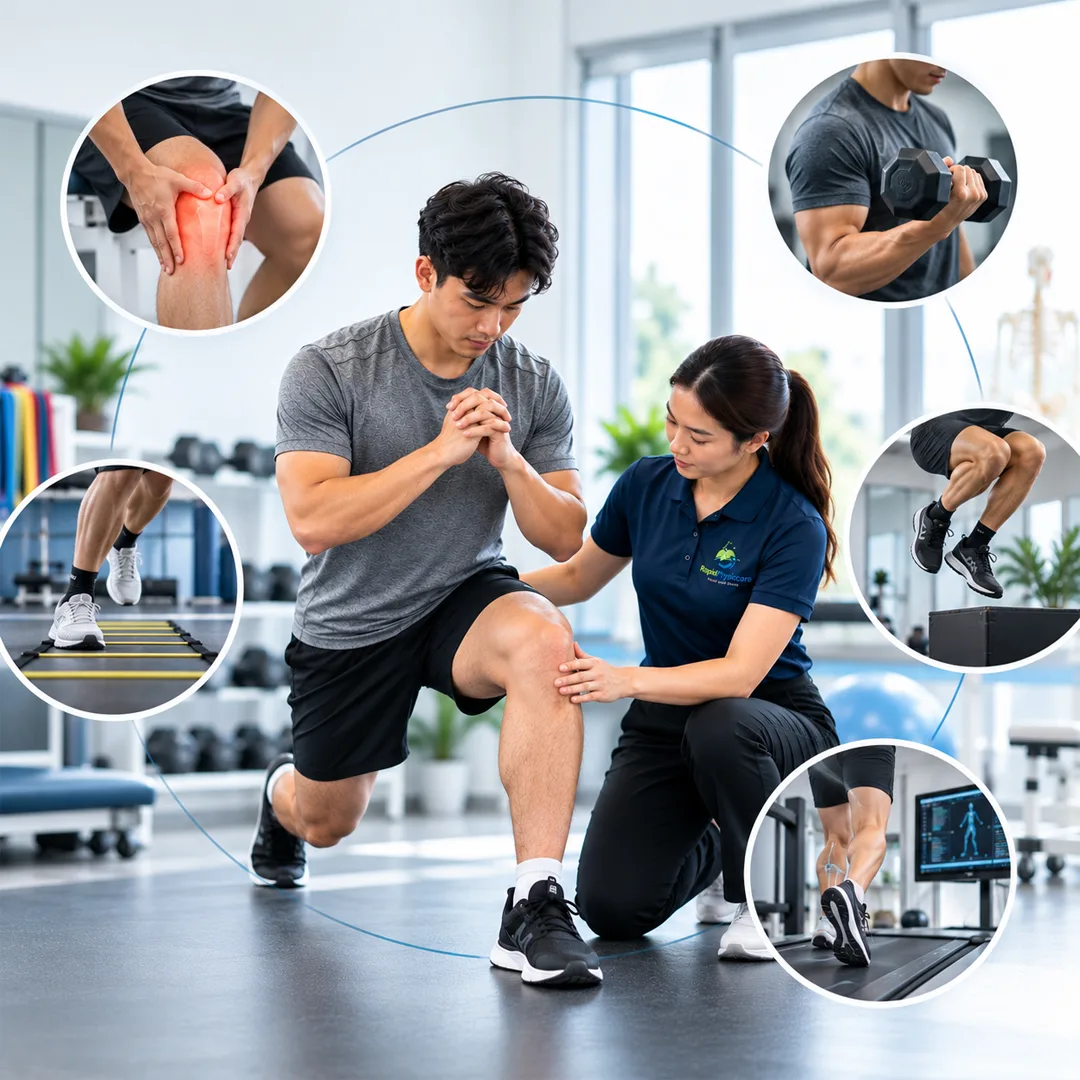
What Is Sports Physiotherapy?
Sports physiotherapy is rehabilitation built around the specific demands of your sport, not just the injured area. It addresses pain, restores movement, rebuilds strength, and prepares your body for the actual loads of competition: cutting, landing, sprinting, overhead reach, whatever your sport requires.
Rest alone does not resolve the underlying cause. It quiets the pain temporarily, but the mechanical problem behind it, a muscle imbalance, a loading pattern, a joint that’s lost stability, stays exactly where it was until it’s addressed directly.
Recovery Focus Areas:
- Pain Management, Movement Restoration, Strength Rebuilding, Sport-Specific Loading and Return-to-Sport Testing
Common Challenges After a Sports Injury
Recovery looks different for everyone, but most athletes face similar physical hurdles after an injury.
One detail we see often: the pain reported isn’t always where the actual problem is. A weak gluteus medius (hip stabiliser) can show up as knee pain during a run, because the knee absorbs load the hip should be controlling. This is why assessment starts above and below the painful joint, not just at it.
Common Sports Injuries We Provide Rehabilitation For
Our physiotherapists support recovery across a wide range of sport-related injuries, with rehabilitation plans built around your sport’s specific demands.
- Hamstring and calf strains
- Achilles and patellar tendinopathy
- Rotator cuff strains
- ACL and MCL sprains
- Ankle ligament sprains
- Shoulder instability
- Stress fractures
- Overuse injuries from repetitive training
- Post-surgical sports injury rehabilitation
No two athletes recover the same way, even with the same diagnosis. Your treatment plan follows your presentation, your sport, and your competition calendar, not a fixed protocol.
Sport-Specific Injury Patterns We See in Singapore
Different sports load the body differently, and that shapes both the injury and the rehabilitation plan.
| Sport | Common Injuries | Why It Happens |
|---|---|---|
| Football / Futsal | Hamstring strains, ankle sprains, ACL injuries | Sudden sprinting, direction changes, and contact on artificial turf |
| Running (road & park connectors) | Shin splints, Achilles tendinopathy, IT band syndrome | Repetitive impact, often with a sudden jump in weekly mileage |
| Badminton | Shoulder impingement, Achilles ruptures, knee ligament sprains | Repeated overhead smashes combined with rapid lunging |
| Swimming | Rotator cuff strain, swimmer's shoulder | High-volume overhead repetition with limited recovery between sets |
| Gym / Strength Training | Lower back strain, rotator cuff tears | Poor lifting technique or loading progressing faster than tissue tolerance |
We ask about your sport in the first five minutes of assessment. A badminton shoulder and a swimmer’s shoulder can look identical on the surface and need completely different rehabilitation sequencing.
Signs You Shouldn't Wait to Get Assessed
Most sports injuries respond well to structured rehabilitation. A smaller number need urgent attention. Seek assessment promptly if you notice:
- A joint that feels unstable or gives way during normal walking
- Visible deformity, or inability to bear any weight
- Swelling that worsens rather than improves after 48 hours
- Numbness, tingling, or loss of sensation below the injury site
- Pain that wakes you at night or doesn’t ease with rest
None of these are meant to alarm you. They’re meant to help you know when “wait and see” has stopped being the safer option.
Your Recovery Journey
Physiotherapy aims to reduce pain, restore movement, rebuild strength, and help you return to sport through evidence-based treatment.
| Phase | Typical Duration | Focus |
|---|---|---|
| Acute | Days 1–7 | Pain relief, protection |
| Subacute | Weeks 2–6 | Restoring range of motion |
| Recovery | Weeks 6–12+ | Strength, sport-specific control |
Timelines are general guides. A grade 1 hamstring strain and a grade 3 ligament sprain do not follow the same calendar, and your physiotherapist sets specific milestones after assessment.
How We Decide You're Ready to Return to Sport
Returning too early is one of the biggest drivers of reinjury. Rather than clearing you on pain alone, we assess readiness using objective measures: strength symmetry between your injured and uninjured limb (typically 90% or above before high-load activity), single-leg hop testing for control and confidence, sport-specific movement drills under controlled conditions, and how the injury responds to load at game intensity, not just daily activity.

FAQs
Frequently Asked Questions
It’s built around the movement demands of your sport specifically, cutting, jumping, overhead reach, rather than general daily function. Rehabilitation targets the loads you’ll actually return to, not just pain-free walking.
As early as possible. Waiting doesn’t just delay treatment; it gives compensatory movement patterns time to form, and those often take longer to unwind than the original injury.
Some treatment techniques, including manual therapy and progressive loading exercises, can cause mild, temporary discomfort as tissue is challenged. This is different from sharp or worsening pain, which your physiotherapist adjusts for immediately.
Yes. You can book directly. We refer you for imaging or a specialist opinion if your presentation needs one.
We’ll tell you directly if surgical referral is appropriate, and support your recovery both before and after.
When Should You Start Physiotherapy?
The ideal time to begin depends on your injury and its severity. You may benefit from an assessment if pain isn’t improving as expected, swelling remains significant, movement feels unstable, or your doctor has recommended rehabilitation.